
Paper Title: Gamification and the impact of extrinsic motivation on needs satisfaction:Making work fun?
Authors: Mitchell, R., Schuster, L. & Jin, H.S. (2020).
Journal of Business Research, 106:323-330. doi.org/10.1016/j.jbusres.2018.11.022
Summary of the paper content
Gamification influences and/or modifies behaviour. As game design primarily aims to engage and motivate players to behave in a particular way, use of gamification in the business world aims to stimulate employee engagement and motivation, and thus boost productivity and growth. However, some research suggests gamification can have negative outcomes (Perryer et al, 2016, Callan et al., 2015). A key concept of the self-determination theory (SDT) is that intrinsic motivation (personal satisfaction, enjoyment) is driven by individual needs satisfaction that result from competence, autonomy and relatedness needs (Deci & Ryan, 2002). Inwork environments, needs satisfaction positively correlates with employee well-being, engagement and improved performance but facilitation of extrinsic motivation (the fear of reprisal, reward gain) to perform work tasks through rewards that are not meaningful or social pressure may reduce intrinsic motivation despite initial organizational benefits (Kim & Werbach, 2016). This research paper looked at both sides using SDT to assess i) how gamification influences employee intrinsic versus extrinsic motivation and ii) how they impact overall satisfaction and future task performance. By conducting an online survey in various workplace and application contexts showed perception of social pressures, rewards and/or punishments during gamification reducedpsychological needs satisfaction and employee productivity. However, when a personal benefit was perceived gamification supported satisfaction and motivation.
A: Quality of research
The objectives of the paper were very clearly stated in this paper. The research question is a pertinent one that deserves more study as implementation of gamification is projected to significantly improve employee satisfaction, engagement and motivation in the work environment. Better insight of how to align gamification apps to employee satisfaction needs while simultaneously promoting company objectives could dramatically influence business success. The benefits became even more apparent from the extensive background of the field as well as highlighted knowledge gaps presented by the authors that formed the main thread throughout the article.
To my knowledge the study is unique as it recruited not a small number of individuals from different industries that actual use gamification apps. This moves away from theoretical aspects of many papers and subjects the data to important real-world analysis. Furthermore, my literature searches suggest that most studies focus on use of intrinsic – but not extrinsic – motivations in game dynamics.
Although clear ethical issues were not apparent, some important limitations are associated with this study. For example, a gender bias towards males was noted. This could be important as data suggests female players are less attracted to competitive online games and find them less playful than their male counterparts (Wang & Wang 2008), although another study suggested this finding is likely to be context dependent (Codish & Ravid, 2017). Mitchell et al (2020) also did not take into account impact of the inverse relationship between satisfaction and expectation as highlighted by the expectations disconfirmation theory (Caporarello et al, 2019) – baseline satisfaction was not assessed. Age-related effects were not considered or that many different apps were used by the study participants one of which, habitica, dominated. It cannot be ignored that emphasis in the different apps would also affect participant responses as shown by others (Alsawaier, 2018). On a positive note, the authors adressed some of these issues in the article limitations and future research section.
B: The research method
291 people were recruited for this study predominantly from information, education services, and finance/insurance industries. Most were male (68%; mean age 31 years, range 19 – 62 years) and were using a gamification application (please see paper details) at the time of study (75%), the rest had used one in the prior three months. In most cases gamification was voluntary and introduced to improve productivity, track task completion/compliance or assess education/training. The authors conducted online surveys in variousworkplace and application contexts, a method that is quite appropriate for their study. The method is described in detail with examples of the questions highlighted – but the paper would have benefitted from inclusion of all the questions asked. As far as I can see the analyses were performed accurately with emphasis on statistical interpretation and the conclusions drawn were supported by the obtained data.
C: Quality of presentation
In my humble opinion this study was well presented with clear objectives, transparent inclusion and exclusion criteria as well as somewhat sufficient insight to the questions that generated the data. Its structure, use of minimal abbreviations and the fact that all concepts were explained in detail allowed even a beginner like myself to appreciate the study and its outcome.
C: Additional notes
Four major findings from this paper are worth highlighting;
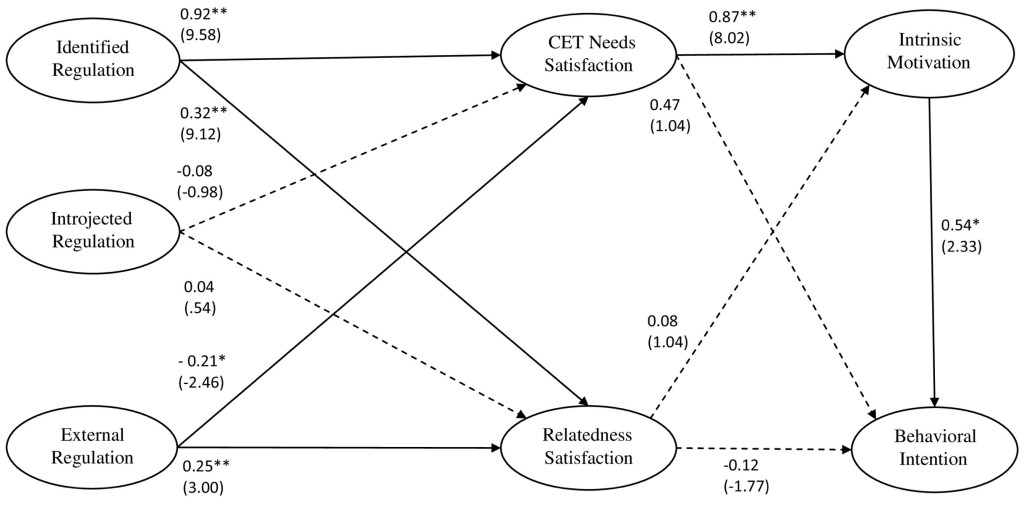
1. Gamification applications satisfied relatedness needs of participants but did not influence their intrinsic motivation to use the app.
2. Autonomy and competence needs satisfaction underlie intrinsic motivation and positively influence behavioral intention as noted by others.
3. Using gamification apps to avoid repercussions, gain rewards or during social pressure reduce employee autonomy and competency needs satisfaction. Surprisingly, relatedness needs satisfaction was positively influenced.
4. Gamification applications that provided useful benefits were much more likely to fulfill autonomy, competence and relatedness needs overall.
Below I present the paper summary figure shows a great overview of how specific needs and motivations impact one another.
Conclusion
Overall, I conclude that one size will not fit all – gamification in the work environment must be interesting and engaging but also meaningful for employees. Tailoring gamification to employee groups could reap significant benefits.
Word count: 900
References
Alsawaier, R.S. (2018). The effect of gamification on motivation and engagement. International journal of Information and Learning Technology, 35(1): 56-79. doi: org/10.1108/IJILT-02-2017-0009
Callan R.C., Bauer K.N., Landers R.N. (2015) How to Avoid the Dark Side of Gamification: Ten Business Scenarios and Their Unintended Consequences. In: Reiners T., Wood L. (eds) Gamification in Education and Business. Springer, Cham. doi: org/10.1007/978-3-319-10208-5.
Caporarello L., Magni M., Pennarola F. (2019) One Game Does not Fit All. Gamification and Learning: Overview and Future Directions. In: Lazazzara A., Nacamulli R., Rossignoli C., Za S. (eds) Organizing for Digital Innovation. Lecture Notes in Information Systems and Organisation, vol 27. Springer, Cham. doi: book/10.1007/978-3-319-90500-6.
Codish, D. & Ravid, G. (2017). Gender moderation in gamification: does one size fit all? Proceedings of the 50th Hawaii International Conference on System Sciences. http://hdl.handle.net/10125/41398
Deci, E. L., & Ryan, R.M. (2002). Handbook of self-determination research. University Rochester Press, Rochester. Pg. 3-35.
Gagné, M. & Deci, E.L. (2005). Self-determination theory and work motivation. Journal of Organizational Behavior, 26(4): 331-362 https://doi.org/10.1002/job.322.
Kim, T.W. & Werbach, K. (2016). More than just a game: ethical issues in gamification
Ethics and Information Technology, 18(2): 157-173. doi: org/10.1007/s10676-016-9401-5.
Kumar J. (2013) Gamification at Work: Designing Engaging Business Software. In: Marcus A. (eds) Design, User Experience, and Usability. Health, Learning, Playing, Cultural, and Cross-Cultural User Experience. DUXU 2013. Lecture Notes in Computer Science, vol 8013. Springer, Berlin, Heidelberg. doi: org/10.1007/978-3-642-39241-2_58.
Perryer, C., Celestine, N.A., Scott-Ladd, B. & Leighton, C. (2016). Enhancing workplace motivation through gamification: Transferrable lessons from pedagogy. The international journal of management education, 14(3): 327-335. doi: org/10.1016/j.ijme.2016.07.001.
Wang, H.Y. & Wang, Y.S. (2008). Gender Differences in the Perception and Acceptance of Online Games.British Journal of Educational Technology, 39(5):787-806.


Leave a Reply