
Introduction
The digital revolution has provided the opportunity to collect, store and analyse huge amounts of data. Already more than 10 years ago companies using big data performed better than those that did not (Brynjolfsson et al. 2011) and this is even more evident today (Chatterjee et al, 2021, Chen et al 2012). As data-driven decision-making adds value to a business by boost productivity, efficiency and growth (Chatterjee et al, 2021; Marshall 2020), it is unsurprising that virtually all sectors – economic, health, public, academic, transport, governmental sectors and commercial industries etc etc – have joined the big data party. Using big data analytics is an essential tool for businesses to ensure they are not increasingly left behind in the brave new digital world.
So what’s in a name? How big is big?
The “big” label suggests more not a small amount of information Although defined in terms volume, velocity, variety and veracity by Schroeck (2012), the minimum requirement of these dimensions to achieve “big data status” remains undefined. Perhaps this is a moot point as nowadays the dynamic and exponential nature of technological advances means data storage and analysis – by even just our smart phones – continues to rapidly increase.
The evolution and impact of Big data in business
In the current digital climate, companies increasingly seek a competitive advantage through the use of science and technology processes (read big data). The scope of opportunity offered by big data analytics (BDA) is continuously being redefined and innovated. Big data propels business growth by enabling multiple datasets that were previously collected and analysed for single purposes, i.e. siloed data, to be linked. Using large data sets also enables data specific connections, as well as those between the data and the people that use it, to be established. This has facilitated identification of key connections previously missed or undetected culminating in better strategic decisions and refinement of business processes. Business can now track customer behavior in real time as well as exploit newer data sources such as social media and online shopping feeds. As a result predictions of customer related preferences, needs as well as trends have also significantly advanced and sharpened business acumen in many sectors (Chatterjee, 2021). A good example is the use of data-driven recommendations/tailoring to enhance customer experience, satisfaction and loyalty (e.g. Amazon, AirBnB, Netflix etc). Similar strategies are also employed in public sectors, banking, health industries etc – its all about using big data to exploit and identify trends as well as improve customer relations. As new links and innovations are constantly being explored the possibilities seem endless. This ever-expanding capacity stems mainly from improved computer processing abilities i.e. increased scale, speed and/or accuracy, rather than fundamentally new activities (Schroeder, 2016). Despite BDA being evolutionary and not revolutionary in nature, it is a considerable force to be reckoned with.
BDA Leaders and followers
Realisation of BDA benefits requires expertise in not only business management per se but also technological strategy, analysis and ethics. Looking for a place to start can be a daunting prerequisite. So what can help to smoothen the path to its benefits? Medeiros et al (2020) suggested the most important points to embrace revolve around data-driven culture, data strategy training, allocation of investments in analytical technologies and data governance and strategy. Perhaps implementing a data-driven culture in itself provides the structural framework for the other points by placing value in digital entrepreneurship, innovation and service development. In this regard a study by Marshall et al (2015) identified different categories of companies – namely leaders, strivers and strugglers – that use big data for innovation as seen in figure 1.
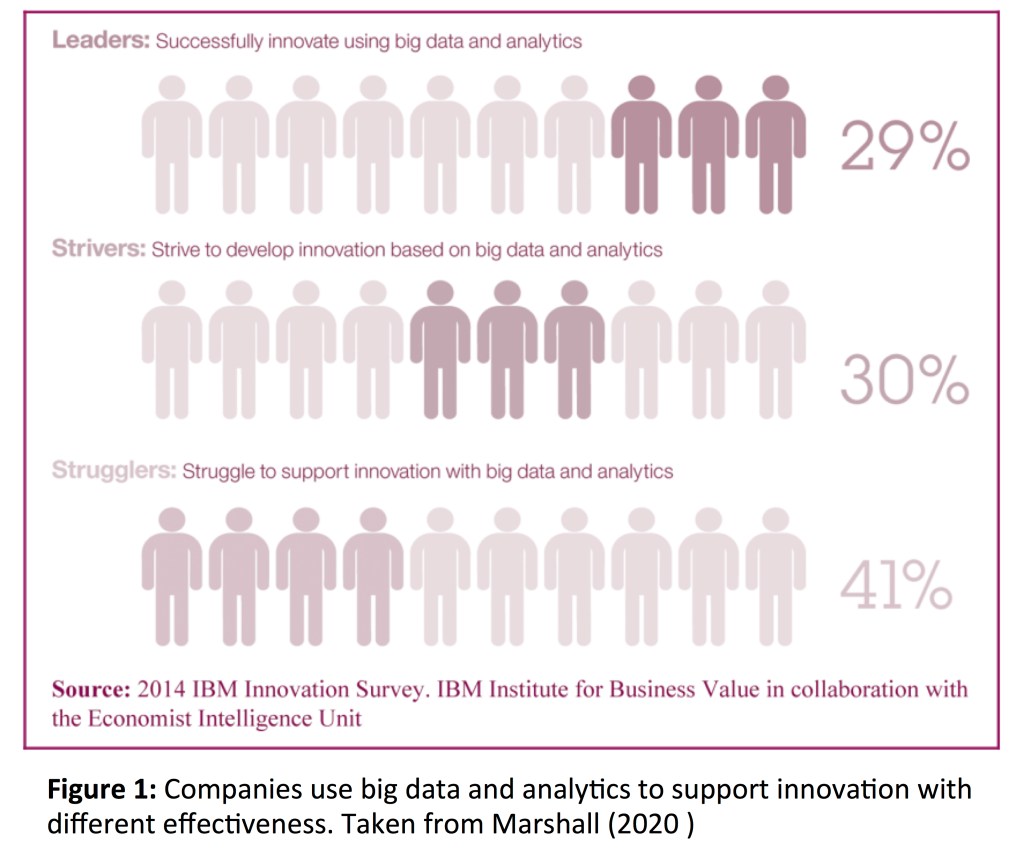
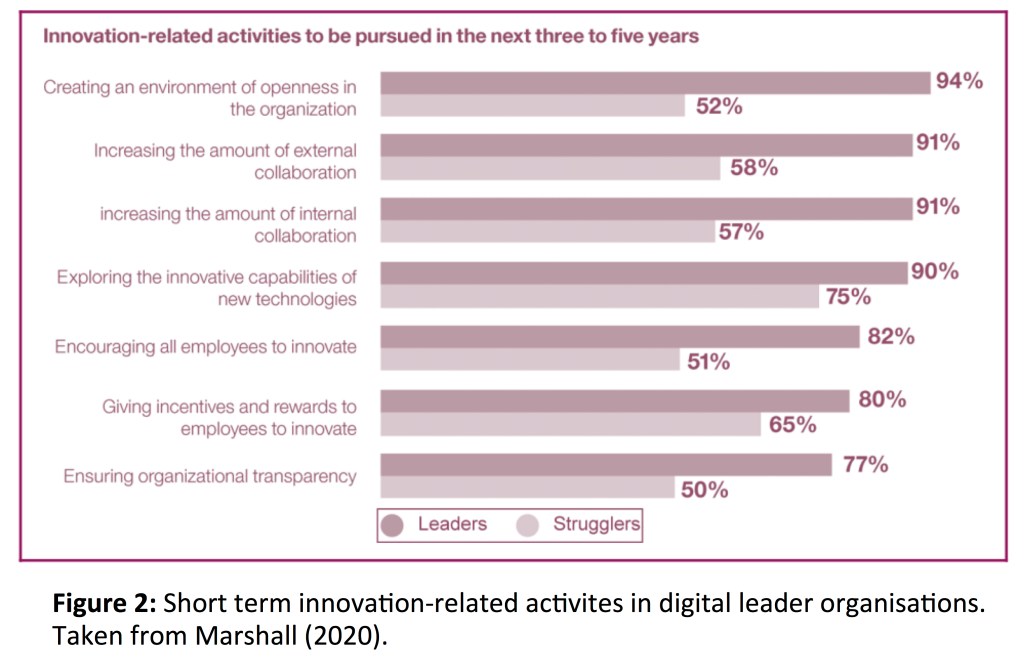
Figure 1 shows that currently only about 30% of companies are able to successfully harness the potential of BDA. The Chinese online and mobile company Alibaba, is a good example of a leader as it strives to educate all of its employees on big data, promotes information transparency and data sharing as well as digital innovation (Marshall 2020). Digital leaders frequently advocate strong integration of digital culture into all business areas and have a highly flexible and innovative outlook overall as seen in figure 2 below.
Lots of challenges
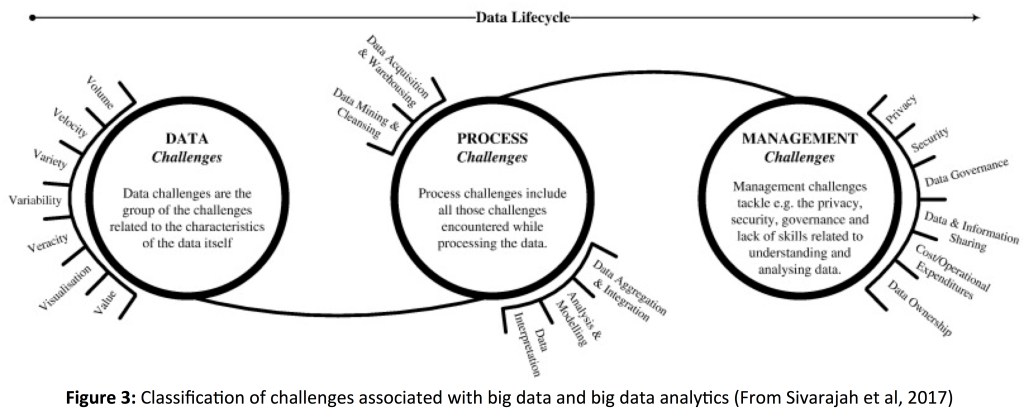
The many challenges associated with big data and BDA have been classified into 3 areas as shown in figure 3, but some can be particularly highlighted;
1. Cost: Entering the BDA world requires a solid investment. Cost-value benefits must be properly evaluated and strategic goals should determine data acquisition. Additionally, technical and storage costs should not to be underestimated (Schroeder & Halsall, 2016). Indeed, more may not always be more.
2. Recruiting a quality IT team: They must understand how to reach specific company goals, foresee software compatibility issues, rapidly adapt to technological changes to ensure future access and adhere to industry standards.
3. Data mining and acquisition methods must be excellent: Poor data collection limits benefit realization. Accurately analyzing big data sets is directly linked to performance (Gandomi & Haider, 2015).
4. Increasing security concerns: An area of significant tension between the collectors (companies) and consumers/individuals that provide the data (Medeiros et al 2020). How to ensure data privacy and instill customer confidence? Indeed, how should the information be used?
Extensive research and discussion on these challenges and more can be found in Sivarajah et al (2017).
Conclusion
Employing a data-driven culture influences product and process innovation, sharpens the competitive edge and fosters significant rewards for all business sectors. However, the value of big data and BDA per se is not intrinsic to the data itself but how its output is used. It is increasingly clear that businesses fully committed to promoting a digital culture philosophy at all levels stand to benefit the most.
Word count: 950
References
Brynjolfsson, E., Hitt, L., & Heekyung, K. (2011). Strength in numbers: How does data-driven decision making affect firm performance? doi: 10.2139/ssrn.1819486.
Chatterjee, S., Chaudhuri, R. & Vrontis, D. (2021). Does data-driven culture impact innovation and performance of a firm? An empirical examination. Annals of Operations Research, doi: 10.1007/s10479-020-03887-z.
Chen, H., Chiang, R.H. & Storey, V.C. (2012). Business intelligence and analytics: from big data to big impact. MIS Quarterly, 36(4), 1165.
Gandomi, A. & Haider, M. (2015) Beyond the hype: Big data concepts, methods, and analytics. International Journal of Information Management, 35(2), 137-144.
Marshall, A. (2020). Innovative analytics: How the world’s most successful organizations use analytics to innovate. IBM institute for business value. Retrieved from https://www.ibm.com/downloads/cas/XBPDMW9M on 28th November, 2021.
Medeiros, M. M. D., Hoppen, N., & Maçada, A. C. G. (2020). Data science for business: Benefits, challenges and opportunities. The Bottom Line, 33(2), 149–163.
Schroeder, R & Halsall, J. (2016). Big data business models: Challenges and opportunities. Cogent Social Sciences, 2:1, doi: 10.1080/23311886.2016.1166924.
Sivarajah, U., Muhammad, U.S., Kamal, M., Irani, Z & Weerakkody, V. (2017). Critical analysis of Big Data challenges and analytical methods. Journal of Business Research, 70, 263-286. doi: 10.1016/j.jbusres.2016.08.001.

 Birth of a reluctant blogger!!
Leave a comment